Control Arm Bushing Replacement: Press Bushings or Replace the Loaded Arm?
Press new bushings if you have a hydraulic press (or a shop with one) and the ball joint is sound. Buy a loaded control arm assembly if you lack press access or the ball joint is marginal. That is the whole decision, and it comes down to three variables: press access, ball joint condition, and the value of your time versus the price delta between a bushing set and a loaded arm.
A bushing set is cheap on parts but demands tooling and labor. A loaded arm costs more on parts but arrives with the bushing already pressed and, on most designs, a new ball joint and hardware — which removes the two highest-risk steps of the job. If you have a press and a healthy ball joint, pressing bushings is the economical path. If you have neither, the loaded arm is not a shortcut; it is the correct engineering choice.
Either path ends the same way: correct torque at the pivot and ball joint fasteners, plus a professional alignment. The job is not finished when the last bolt is snugged. [MODEL_ANALYSIS]
Confirm the Bushings Are Actually Bad (and Not the Ball Joint or Tie Rod)
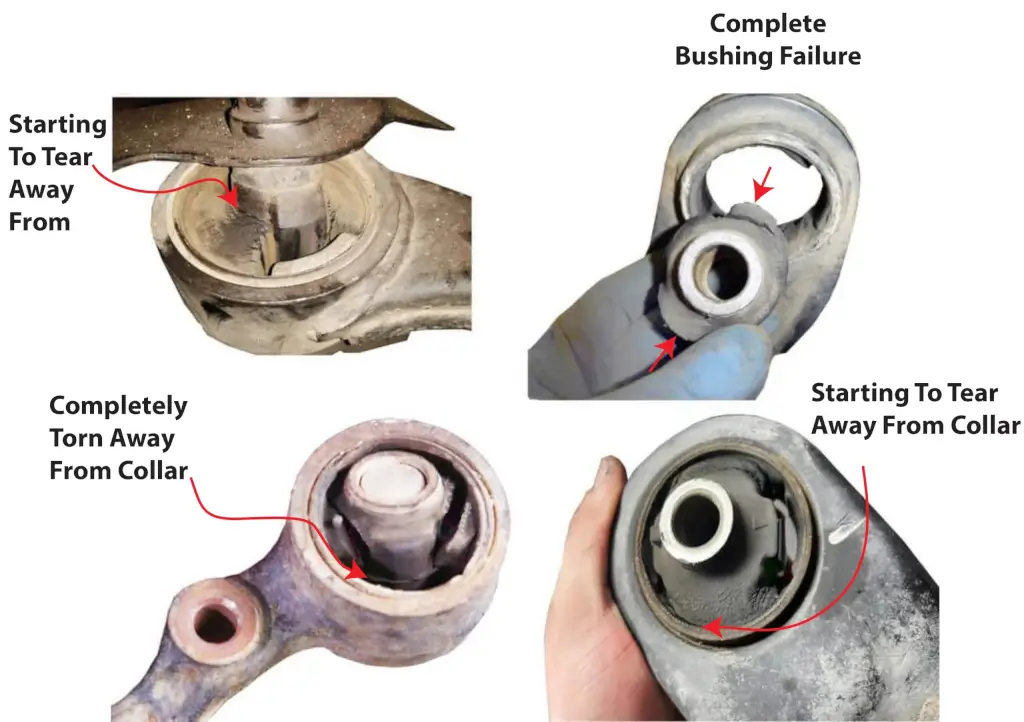
Before buying anything, confirm the bushing is the failed part. The symptom set associated with worn control arm bushings is clunking over bumps, vague or wandering steering, uneven tire wear, and visible cracking or separation of the rubber. [SEARCH_EVIDENCE]
A pry-bar test on the arm with the vehicle safely supported reveals bushing play. Ball joint play is checked separately at the knuckle — grab the tire at top and bottom and rock it, or pry the joint directly. A bad ball joint changes the bushings-versus-arm decision, because if the ball joint is worn you are already buying a loaded arm on most designs.
One caution that separates a real diagnosis from a parts cannon: torn or oil-soaked bushings are a replacement trigger; surface cracking alone is not always a failure. Rubber develops cosmetic surface cracks with age while still holding its compliance and load path. If the bushing is cracked but not torn, not separated, and shows no play under pry load, the noise may be coming from a sway bar link, strut mount, or tie rod end. [MODEL_ANALYSIS]
Rubber vs. Polyurethane: A Manufacturer's Material-Selection View
Rubber is the default for stock applications because it isolates noise, vibration, and harshness while deflecting under load — and that deflection is a feature, not a defect. It is chosen for compliance and long service life in daily-driven vehicles. [MODEL_ANALYSIS]
Polyurethane is typically stiffer, resists deflection and oil/ozone degradation better, and is chosen for performance and durability. The cost is increased road noise, vibration, and harshness transmitted to the cabin. [MODEL_ANALYSIS]
There is a maintenance consequence most buyers miss: polyurethane generally requires lubrication at the bushing/sleeve interface to prevent squeaking. Rubber does not. This is not a one-time install step — it is an ongoing ownership consideration, and it is the single most common reason poly bushings develop a squeak that owners blame on the part rather than the installation. [MODEL_ANALYSIS]
Match the material to the vehicle's role. Daily driver and comfort priority favor rubber. Track, off-road, or heavy-load use favor polyurethane. A lifted truck that sees gravel roads and a commuter sedan should not get the same bushing compound.
Tools, Safety, and the Press Problem: What You Actually Need
A hydraulic press with correctly sized receiver and driver cups is the reliable method for pressing bushings. A ball joint press or bushing driver kit can substitute on some arms, but improvised methods — hammer, all-thread, sockets — risk deforming the arm or tearing the new bushing. [MODEL_ANALYSIS]
Safety essentials: support the vehicle on jack stands on a level surface, never work under a jack alone, and relieve suspension load before loosening pivot bolts. A loaded control arm under spring tension can move suddenly when the last fastener releases. [MODEL_ANALYSIS]
If you cannot source a press or a correct driver set, that alone is a legitimate reason to choose the loaded control arm assembly. It is not a failure of skill; it is a tooling constraint, and the loaded arm is designed to solve exactly that problem. [MODEL_ANALYSIS]
Step-by-Step: Pressing In New Control Arm Bushings
Sequence: safely support the vehicle, remove the wheel, disconnect the ball joint and pivot bolts, remove the arm, then press the old bushing out and the new one in using matched cups. Never drive a bushing in by hammering on the shell. [MODEL_ANALYSIS]
Lubricate polyurethane bushings at the sleeve interface per the bushing maker's instructions. Do not lubricate rubber bushings unless the manufacturer specifies it. [MODEL_ANALYSIS]
Reinstall the arm, hand-thread fasteners, then torque pivot and ball joint fasteners to the vehicle manufacturer's specification with the suspension at ride height where the design requires it. Do not invent or guess torque values — a service manual or the vehicle maker's data is the only acceptable source. [MODEL_ANALYSIS]
Common DIY mistakes to avoid: pressing on the rubber instead of the shell, cocking the bushing in the bore, over-torquing pivot bolts, and damaging the ball joint boot during removal. Each of these turns a two-hour job into a subframe or knuckle replacement. [MODEL_ANALYSIS]
The Step Everyone Skips: Alignment and Why It Is Not Optional
Yes, you need an alignment after replacing control arm bushings. Replacing bushings or a control arm changes suspension geometry at the pivot points; camber, caster, and toe can shift, so an alignment is required to restore the vehicle's spec and protect tire life. [MODEL_ANALYSIS]
Budget an alignment shop visit as a fixed line item in the total job cost, whether you pressed bushings or swapped the arm. [MODEL_ANALYSIS]
Driving on a misaligned suspension after the job accelerates tire wear and can mask whether the repair actually resolved the original complaint. If the car still wanders after new bushings and no alignment, you will not know whether the bushing job failed or the toe is simply wrong. [MODEL_ANALYSIS]
Cost Breakdown: Bushings-Only vs. Whole Arm, DIY vs. Shop
The cost structure has four lines: parts (bushing set vs. loaded arm), tooling (press or driver kit if not owned), labor (DIY hours vs. shop hours), and alignment. [MODEL_ANALYSIS]
DIY pressing is cheapest on parts but requires press access. A loaded arm is higher on parts but lower on tooling and labor risk. A shop doing either path adds labor and alignment. [MODEL_ANALYSIS]
Specific dollar figures and labor hours vary by vehicle and region; treat any number you see online as a range, not a quote. Data unavailable for a universal figure — get a local quote for your specific vehicle. [MODEL_ANALYSIS]
For buyers sourcing parts, the same logic scales: a bushing set and a loaded arm are not competing products, they are two answers to the same problem, and which one is correct depends on the installer's tooling and the ball joint's condition at the bay.
When to Stop and Hand It to a Shop
Stop and book a shop if the arm bore is corroded or deformed, the ball joint boot is torn during removal, the pivot bolt is seized, or you have no press and no correct driver set. [MODEL_ANALYSIS]
A shop can press bushings or install a loaded arm and perform the alignment in one visit, which removes the tooling and alignment variables entirely. [MODEL_ANALYSIS]
For wholesale buyers and importers, the same logic scales: stock both bushing sets and loaded arms so the installer can choose based on tool access and ball joint condition at the bay. Our [automotive suspension components](/products) catalog is organized around that reality — bushings and complete arms for the same applications, so the decision stays with the installer instead of being forced by inventory.
FAQ
Do I really need an alignment after replacing control arm bushings?
Yes. Replacing bushings or a control arm changes suspension geometry at the pivot points; camber, caster, and toe can shift, so an alignment is required to restore the vehicle's spec and protect tire life. [MODEL_ANALYSIS]
Can I press bushings without a hydraulic press?
A ball joint press or bushing driver kit can substitute on some arms, but improvised methods — hammer, all-thread, sockets — risk deforming the arm or tearing the new bushing. If you cannot source a press or a correct driver set, that alone is a legitimate reason to choose the loaded control arm assembly. [MODEL_ANALYSIS]
How do I know if my control arm bushings are bad?
Symptoms include clunking over bumps, vague or wandering steering, uneven tire wear, and visible cracking or separation of the rubber. A pry-bar test on the arm with the vehicle safely supported reveals bushing play. Torn or oil-soaked bushings are a replacement trigger; surface cracking alone is not always a failure. [SEARCH_EVIDENCE][MODEL_ANALYSIS]
Should I use rubber or polyurethane bushings?
Rubber is the default for stock applications because it isolates noise, vibration, and harshness while deflecting under load. Polyurethane is typically stiffer, resists deflection and oil/ozone degradation better, and is chosen for performance and durability, but it increases road noise, vibration, and harshness transmitted to the cabin and generally requires lubrication at the bushing/sleeve interface to prevent squeaking. Match the material to the vehicle's role. [MODEL_ANALYSIS]
What torque should I use on control arm bolts?
Torque pivot and ball joint fasteners to the vehicle manufacturer's specification with the suspension at ride height where the design requires it. Do not invent or guess torque values — a service manual or the vehicle maker's data is the only acceptable source. [MODEL_ANALYSIS]